You go to the gym regularly. You train hard and sweat a lot But months go by and nothing changes – the same strength, the same body. The problem is often not the effort, but the amount of attention you give to the workout. If increasing overload helps you grow, then the amount of training is what controls it. A workout volume calculator helps you measure your work instead of guessing.
Why “Training Hard” Is Not Enough
“Going hard” feels good, but it cannot be measured.
Two people can:
- train equally hard
- feel equally tired
But only one may grow.
Why?
Because growth depends on how much total work you do, not just how tired you feel.
Without tracking volume, you are guessing—and guessing causes plateaus.
What Is Workout Volume? (Simple Meaning)
The most basic formula is:
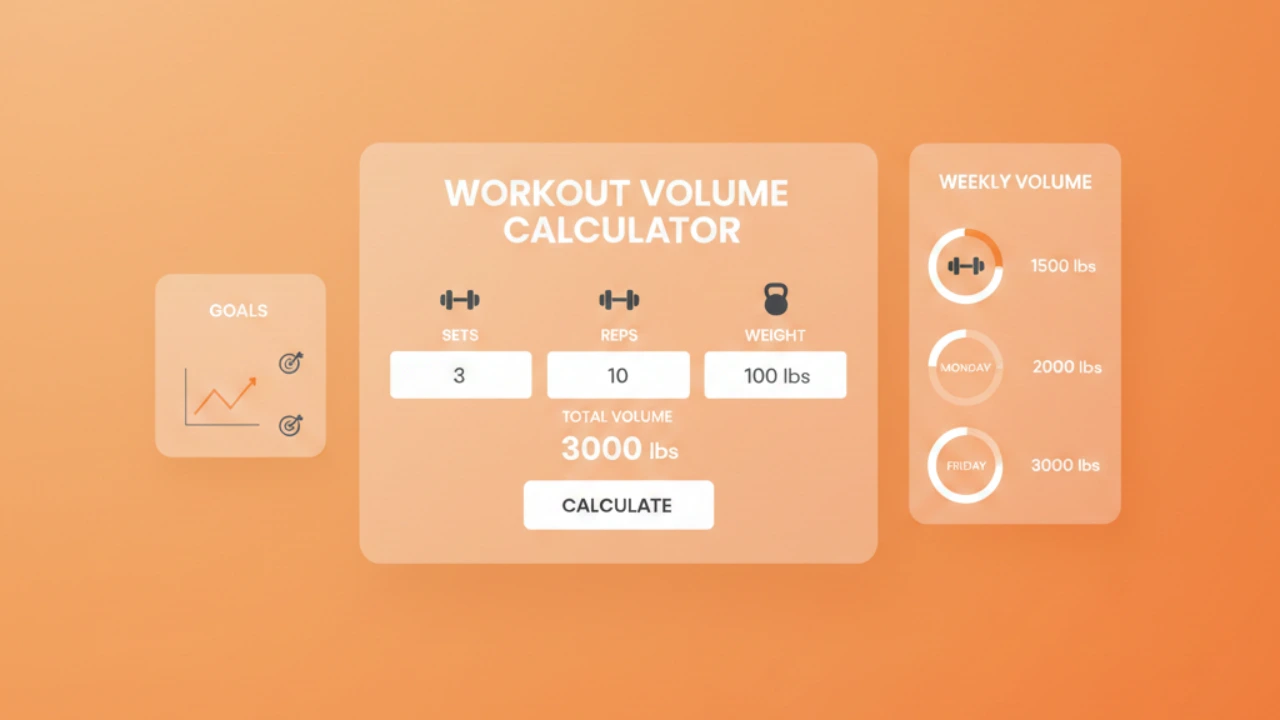
Workout Volume = Sets × Reps × Weight
Example:
- 3 sets × 10 reps × 100 kg
- Total volume = 3000 kg
This is also called tonnage.
Easier Method (Best for Muscle Growth)
Instead of math, many people track:
Hard Sets per Muscle per Week
A hard set is a set done close to failure (you could only do 1–3 more reps).
Example:
- Chest: 12 hard sets per week
- Back: 14 hard sets per week
This is simple and very effective.

A Workout Volume Calculator helps track both methods.
How to Use Volume to Make Progress
Step 1: Track Your Current Volume
For one week:
- Do your normal workouts
- Write down:
- sets
- reps
- weight
- Count hard sets for each muscle
This is your starting point.
Workout Volume Calculator
Step 2: Increase Volume Slowly (Progressive Overload)
To grow, you must slowly do more work over time.
You can increase volume by:
- Adding a set
- 3 sets → 4 sets
- Adding reps
- 3×10 → 3×11
- Adding weight
- Same reps, heavier weight
- Training a muscle more often
👉 Good rule: increase weekly volume by 10–20% only.
Too much = fatigue and injury.
Step 3: Use Volume to Plan Rest (Deload)
After 3–6 weeks of increasing volume:
- reduce volume by 40–60% for 1 week
- this is called a deload
This helps:
- recovery
- muscle growth
- better performance later
A calculator makes this easy to plan.
Big Mistake: Too Much “Junk Volume”
More is not always better.
After a limit, extra volume:
- does not build muscle
- only increases fatigue
This limit is called MRV (Maximum Recoverable Volume).
Signs of too much volume:
- joint pain
- poor sleep
- low motivation
- weaker lifts
Most people grow best with:
- 10–20 hard sets per muscle per week
Find the lowest amount that works, then increase slowly.
Example: Sarah’s Shoulder Training
Sarah wants stronger shoulders.
Week 1 (Start)
- Overhead Press:
- 3 sets × 8 reps × 65 lbs
- Volume = 1,560 lbs
- Total shoulder hard sets per week: 12
Week 2 (More Reps)
- 3 × 9 × 65 lbs
- Volume = 1,755 lbs
- Progress made safely
Week 4 (More Weight)
- 3 × 8 × 70 lbs
- Volume = 1,680 lbs
- Heavier weight = stronger stimulus
Week 6 (More Sets)
- 4 × 8 × 70 lbs
- Volume = 2,240 lbs
- Big improvement
Week 7 (Deload)
- 2 × 8 × 60 lbs
- Volume = 960 lbs
- Body recovers and grows
This planned cycle leads to real progress.
Your Simple Action Plan
- Track hard sets per muscle per week
- Write your current weekly volume
- Choose ONE way to increase volume
- Track every workout
- If you feel good → continue
If tired → reduce volume - Take a deload every 4–8 weeks
Final Thoughts
A Workout Volume Calculator does not replace hard work.
It makes your hard work effective.
Instead of:
“I think I trained harder”
You can say:
“I increased my back volume by 15% this month”
That is how progress happens.
Train smart.
Measure your work.
Let volume drive your results.
FAQ
Q: Should I track tonnage or hard sets?
For muscle growth, hard sets are easier and work very well.
Tonnage is more useful for strength athletes.
Q: How do I track bodyweight exercises?
Count:
- hard sets
- reps
To progress:
- add reps
- add sets
- add weight (vest, belt)
- use harder variations
Q: Do beginners need less volume?
Yes.
Beginners grow well with 6–10 hard sets per muscle per week.
Advanced lifters need more volume to grow.


