You’re hitting your workouts. You’re hitting your protein goals. You’re meal prepping. But did you know that if you skip sleep, you’re missing the most crucial piece of the muscle-building puzzle – and it’s going to undo all your hard work.
Here’s the truth: Muscles don’t grow in the gym. They grow when you sleep properly. It’s easy to understand the science behind this and optimize your sleep for recovery.
The Science of Sleep and Muscle Growth
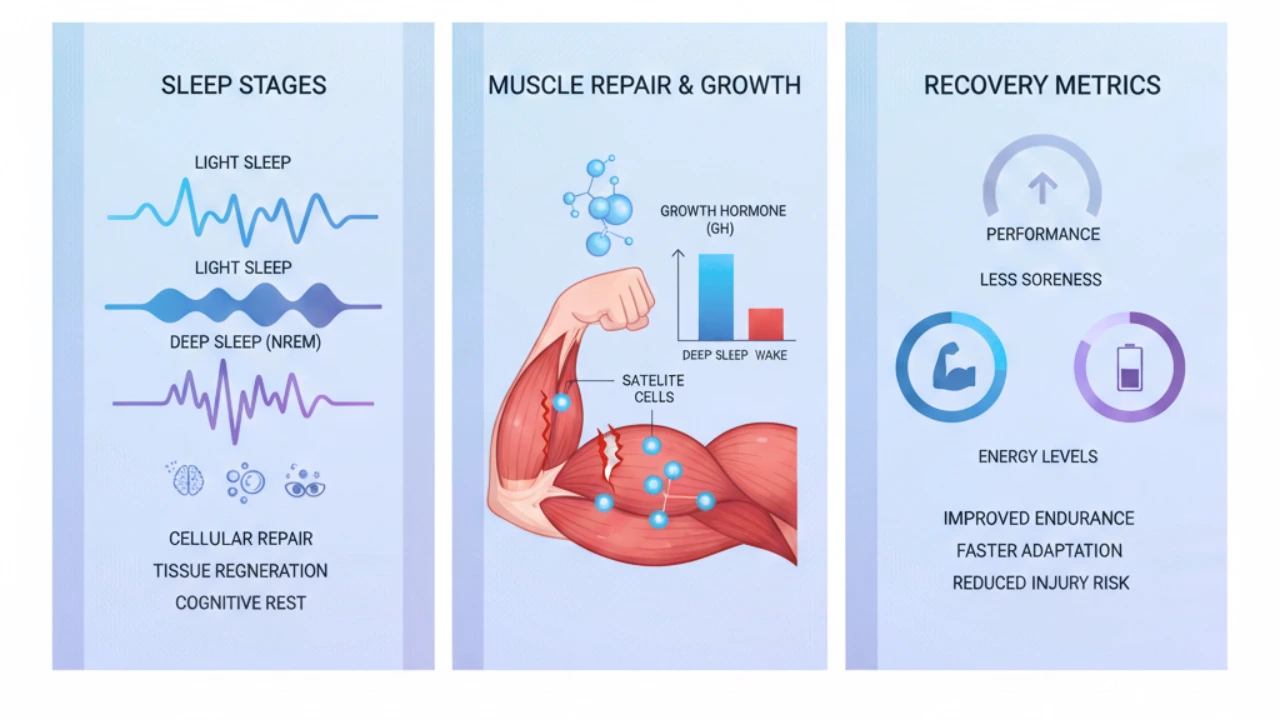
Think of your gym session as the first step in building new muscle. When you lift weights, you create microscopic tears in your muscle fibers. Your body’s response to this stress is what causes growth. But the real building happens when you sleep.
Deep sleep And Growth Hormone
During deep sleep, especially during REM and slow-wave sleep stages, your body releases a surge of growth hormone – the hormone that helps repair and grow muscles. Growth hormone stimulates muscle protein synthesis, a process that helps your body repair those small tears and rebuild them stronger and bigger. Without enough quality sleep, that repair process won’t happen, meaning your muscles won’t fully recover, and your gains will come to a halt.
Cortisol The stress Hormone
Sleep is when cortisol (your stress hormone) levels drop. High cortisol levels break down muscle tissue and inhibit protein synthesis, which directly works against your muscle-building goals. Getting enough sleep keeps cortisol in check and creates an anabolic environment that’s ideal for growth.
How Much Sleep Do You Actually Need?
8 hours is a good starting point, but needs are not the same for everyone. While most adults need 8-9 hours a night, if you’re training hard, it’s a good idea to get more sleep.
Research shows that athletes in intensive training phases benefit from 8-10 hours of sleep per night. Your individual needs will depend on training intensity, stress level, age, and genetics, and how much sleep you need to increase. It’s best to start with the most basic regimen and adjust based on how you feel and perform.
Signs You’re Not Sleeping Enough for Recovery
If you’re experiencing any of these, your sleep duration or quality might be compromised:
- Constantly feeling sore for days after workouts (delayed recovery)
- Hitting a wall in your workouts or inability to progress
- Feeling unusually irritable, anxious, or experiencing mood swings
- Getting sick more often or noticing slower recovery from illness
- Difficulty concentrating or brain fog throughout the day
- Increased appetite or cravings for junk food
- Persistent fatigue that coffee can’t fix

Your Sleep Quality Checklist
Duration is only half the equation. Sleep quality matters just as much. Here’s what to optimize:
Consistency: Go to bed and wake up at roughly the same time, even on weekends. This regulates your circadian rhythm and improves sleep quality significantly.
Environment: Make your bedroom a sleep cave—dark, quiet, and cool (aim for around 65°F or 18°C). Use blackout curtains, earplugs if needed, and consider a white noise machine. A poor sleep environment can reduce sleep quality by up to 30%.
Unplug: Avoid screens (phone, tablet, TV) for at least 30-60 minutes before bed. Blue light from devices suppresses melatonin production, making it harder to fall asleep.
Wind Down: Develop a pre-sleep routine. This might include stretching, meditation, reading, or taking a warm bath. Signal to your body that it’s time to transition to sleep.
Limit Caffeine: Avoid caffeine after 2 PM, as it can have a half-life of 5-6 hours, disrupting sleep even if you don’t feel it.
Watch Alcohol: While alcohol might help you fall asleep, it significantly reduces sleep quality and can suppress growth hormone release.
Calculate Your Optimal Sleep Duration
While individual needs vary, this science-backed formula gives you a personalized starting point:
Start with 480 minutes (8 hours) as your baseline. Then adjust based on your training:
- Add 15 minutes for every hour of moderate-to-intense exercise you do in a day
- Subtract 15 minutes if you had a completely sedentary day (but don’t go below 7 hours)
Example: You trained hard for 1.5 hours today.
- Baseline: 480 minutes
- Add for training: 1.5 hours × 15 minutes = 22.5 minutes
- Total: 502.5 minutes ≈ 8.4 hours
Use this as a flexible guide, not a strict rule. Listen to your body. If you need 9 hours to feel truly refreshed and recovered, honor that. Your individual genetics play a role—some people are “short sleepers” who thrive on 7 hours, while others are “long sleepers” who genuinely need 9-10.
The Bottom Line
Muscles don’t grow just by working out in the gym – they grow when you sleep. It’s during sleep that protein synthesis occurs, hormones are regulated, and the nervous system recovers. That’s no small feat; it’s essential for any serious athlete.
Treat your sleep schedule the same way you treat your exercise and nutrition. Optimize your sleep environment, maintain consistency, and dial in your individual sleep needs.
FAQ
Q: Does napping help with recovery?
A: Yes, but in moderation. A 20-30 minute power nap can boost alertness and recovery, but longer naps can interfere with nighttime sleep. Avoid napping less than 8 hours before bedtime.
Q: I’m doing everything right but still not seeing gains. Could it be sleep?
A: Absolutely. Poor sleep quality or insufficient quantity is one of the most overlooked factors in muscle building. Before changing your program or diet, try optimizing sleep for 2-3 weeks and track the difference.
Q: What if I work night shifts?
A: Night shift workers face a real challenge. Prioritize sleep duration whenever possible, keep your sleep space as dark and cool as possible, and consider melatonin supplementation (0.5-3mg) under professional guidance. Consistency—even if your sleep schedule is shifted—is still critical.
Q: Is sleeping too much bad for gains?
A: Excessive sleep beyond 10 hours regularly can sometimes indicate underlying issues like sleep apnea or depression that warrant medical attention. However, for most intense athletes, 9-10 hours is beneficial, not excessive.
Q: How long before sleep improves my gains?
A: You’ll notice improved recovery and energy within 2-3 weeks of consistent quality sleep. Actual performance improvements and muscle growth benefits typically become noticeable within 4-6 weeks.