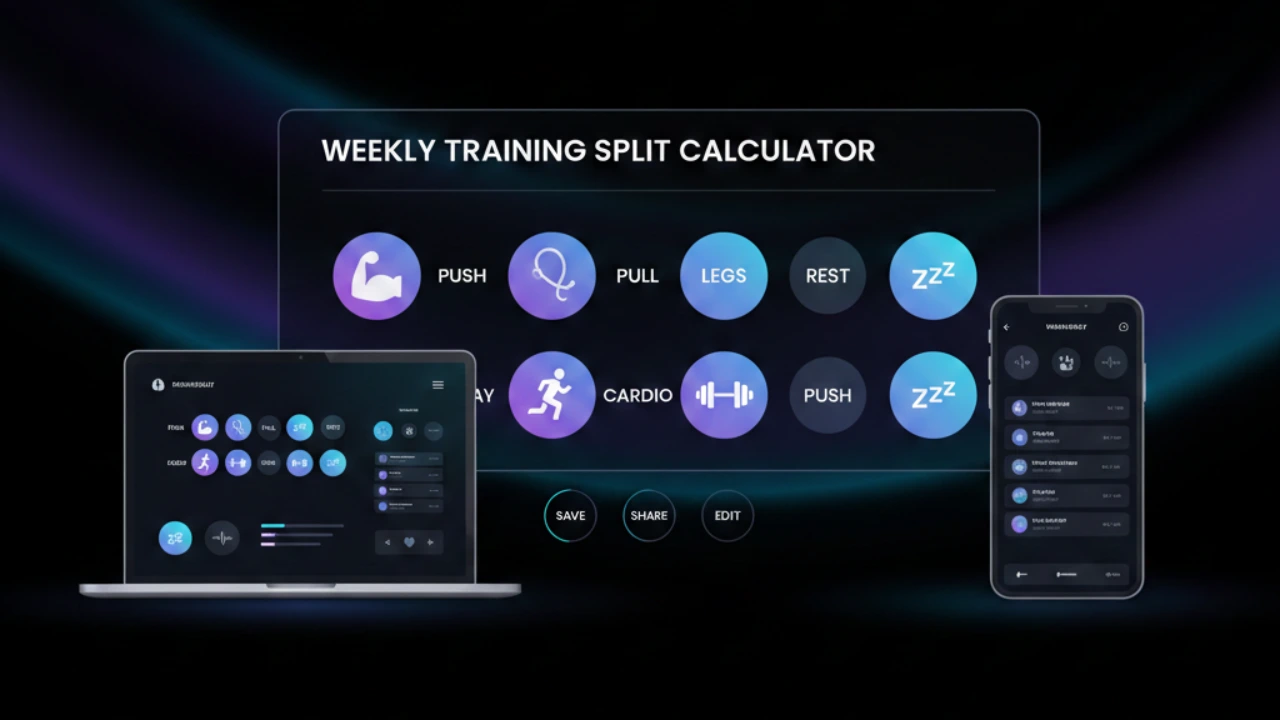
Most gym goers get to the gym and think, “What should I train today?”, “Have I trained my legs yet this week?”, “Have I missed any muscle groups?” Many people make this mistake. This is an example of how most people fail not because they don’t work hard.
This mistake is made because there is no clear plan. The solution to this is a weekly training split calculator that removes the confusion and provides a simple weekly workout plan that fits your life, goals, and recovery capacity.
What Is a Weekly Training Split Calculator?
A Weekly Training Split Calculator helps you decide what to train on each day of the week.
Instead of guessing, it creates a structured workout schedule based on:
- how many days you can train
- your fitness goal
- your experience level
- your recovery ability
This weekly schedule is called a training split.
Common Training Splits (Easy Explanation)
Here are the most common splits a calculator may suggest:
1. Bro Split
- One muscle group per day
Example:
- Chest day
- Back day
- Leg day
Best for people who train 5–6 days per week.
2. Push / Pull / Legs (PPL)
- Push: Chest, shoulders, triceps
- Pull: Back, biceps
- Legs: Quads, hamstrings, glutes
Very popular for muscle growth and balance.
3. Upper / Lower Split
- Upper body one day
- Lower body the next day
Perfect for 4 days per week.

4. Full Body Split
- Train all major muscles in one workout
- Usually 3 days per week
Best for beginners or busy people.
Weekly Training Split Calculator
How to Use a Weekly Training Split Calculator (Step by Step)
Step 1: Enter Your Details (Be Honest)
The calculator will ask for:
✔ How Many Days You Can Train
Not your “perfect week”, but your real routine:
- 3 days
- 4 days
- 5 days
This is the most important input.
✔ Your Main Goal
Choose one:
- Muscle building
- Strength
- Fat loss
- General fitness
✔ Your Experience Level
- Beginner (less than 1 year):
Full body or upper/lower works best - Intermediate (1–5 years):
Push/Pull/Legs or 4-day splits - Advanced (5+ years):
Higher volume and detailed splits
✔ Recovery Factors (Optional)
Some calculators also ask about:
- sleep quality
- stress level
- injuries
This helps prevent overtraining.
Step 2: Get Your Weekly Split
After entering your details, the calculator gives you a plan.
Example 1
Input: 3 days, muscle building, beginner
Output: 3-day full body split
(Monday – Wednesday – Friday)
Example 2
Input: 4 days, strength, intermediate
Output: Upper / Lower split
(Upper – Lower – Rest – Upper – Lower)
Now you know exactly what to train each day.
Step 3: Add Exercises to Each Day
The calculator gives the structure.
You choose the exercises.
Simple Rule:
1️⃣ Start with compound exercises
- Squats
- Deadlifts
- Bench press
- Rows
- Overhead press
2️⃣ Then add isolation exercises
- Bicep curls
- Tricep pushdowns
- Leg extensions
- Lateral raises
Example: Push Day (PPL Split)
- Bench Press
- Overhead Press
- Incline Dumbbell Press
- Tricep Dips
- Lateral Raises
Simple and effective.
Step 4: Follow, Track, and Adjust
Follow your split for 6–8 weeks.
Track:
- exercises
- sets
- reps
- weights
Try to improve slowly:
- more reps
- more weight
- better form
After 8 weeks:
- feeling bored?
- stuck?
- schedule changed?
Use the calculator again and update your plan.
Why a Weekly Training Split Calculator Is So Powerful
1️⃣ No More Confusion
You walk into the gym knowing exactly what to do.
2️⃣ Better Recovery
Muscles need 48–72 hours to recover.
A good split prevents overtraining and injuries.
3️⃣ Balanced Muscle Growth
No more:
- big chest, weak back
- strong arms, weak legs
Everything stays balanced.
4️⃣ Fits Your Lifestyle
A 6-day plan is useless if you can train only 3 days.
This tool matches workouts to real life.
5️⃣ Clear Progress Tracking
You clearly see:
- last week’s weight
- today’s target
This keeps motivation high.
6️⃣ Better Focus in the Gym
No guessing. No random exercises.
Better mind-muscle connection.
Final Thoughts
The Weekly Training Split Calculator is not magic.
It’s structure.
And structure leads to:
- consistency
- better recovery
- steady progress
The best workout plan is the one you can follow long-term.
Stop planning in your head.
Start training with a clear blueprint.
FAQ
Q1: Is this calculator good for beginners?
Yes. Beginners benefit the most because it prevents confusion and overtraining.
Q2: How often should I change my training split?
Every 6–8 weeks is ideal, or when progress slows.
Q3: Can I use this with a Workout Volume Calculator?
Yes. Training split decides when you train.
Volume decides how much you train.
Both work best together.
Q4: Do I still need rest days?
Yes. A good split automatically includes rest or recovery days.


